
The Executive Vice Chairman of the Nigerian Communications Commission (NCC), Dr. Aminu Maida, has called on state governments to harmonize Right of Way (RoW) policies, protect telecom infrastructure, and accelerate investment-friendly reforms to drive broadband expansion and digital inclusion across Nigeria.
Dr. Maida made the call in Abuja on Tuesday at a stakeholders’ roundtable themed “Right of Way and Protection of Broadband Infrastructure – The Road to Success in Broadband Investment and Connectivity.”
He said that in today’s economy, “connectivity is the quiet enabler” of productivity, innovation, and national competitiveness, stressing that its failure could stall growth and even endanger lives in critical sectors.
“When we talk about connectivity, our minds go to faster downloads or smoother video calls, but the scope and impact extend far beyond these,” Maida said. “Connectivity today equals economic inclusion, productivity, and national resilience.”
Nigeria’s Progress and Challenges
According to him, Nigeria’s broadband penetration stood at 48.81 percent as of August 2025, with over 140 million people having access to the internet. The ICT and telecom sector, he noted, remains one of the country’s strongest GDP contributors.
He cited global research showing that a 10 percent increase in broadband penetration can boost GDP by about 1.38 percent in developing countries, adding that higher penetration could yield billions in new economic output and thousands of jobs.
Maida commended the efforts of President Bola Ahmed Tinubu and the Minister of Communications, Innovation, and Digital Economy, Dr. Bosun Tijani, in driving the National Broadband Plan (2020–2025), which targets 70 percent broadband penetration and 90,000 kilometers of fibre deployment by the end of 2025.
The NCC, he said, has implemented several strategic interventions to support these goals, including:
- The Critical National Information Infrastructure (CNII) Presidential Order, signed by President Tinubu in June 2024, which empowers security agencies to protect telecom infrastructure from vandalism and sabotage.
- Sustained advocacy with state governments to reduce or waive Right of Way charges, leading to 11 states now operating zero RoW fees and 17 others aligning with the NGF’s N145 per linear meter benchmark.
- The approval of cost-reflective but competitive tariff rates to encourage new investment, with operators pledging over $1 billion in fresh broadband rollout commitments.
- A wholesale fibre study to promote open access and fair interconnection for service providers.
- Greater data transparency and quality-of-service reporting to ensure accountability in the industry.
Mounting Threats to Infrastructure
Despite the gains, Maida warned that persistent challenges—such as vandalism, theft, and inconsistent Right of Way policies—continue to impede progress.
Between January and August 2025 alone, the industry recorded 19,384 fibre cuts, 3,241 equipment thefts, and over 19,000 denials of access to telecom sites.
“These disruptions cause prolonged outages, revenue losses, and increased security costs,” he said. “They demonstrate why infrastructure protection must be at the centre of our collective agenda.”
Dr. Maida urged state governors to see broadband infrastructure as a shared national priority and to act decisively to eliminate barriers.
“Every governor and state represented in this room holds a strategic lever,” he said. “Waiving RoW charges, protecting telecom infrastructure, and proactively supporting fibre deployment are decisions that can determine the prosperity or stagnation of your states.”
He proposed six key actions for states:
- Partner in enforcing the protection of telecom assets as critical infrastructure.
- Adopt full or benchmark RoW waivers with clear approval timelines.
- Coordinate road and fibre works through “dig-once” protocols.
- Publish transparent processes and fees.
- Create state digital infrastructure funds to attract private investment.
- Support hybrid and solar power solutions for telecom sites to improve uptime.
Looking Ahead
The NCC EVC also announced two upcoming initiatives:
- The Ease of Doing Business Portal, a one-stop digital interface linking all 36 states and the FCT.
- The Nigeria Digital Connectivity Index (NDCI), an annual scorecard ranking states by digital readiness and competitiveness.
“Pipelines of oil are giving way to pipelines of fibre,” Maida concluded. “The digital revolution does not wait. Let us align, invest, and protect—for the prosperity of our people and the future of our nation.”
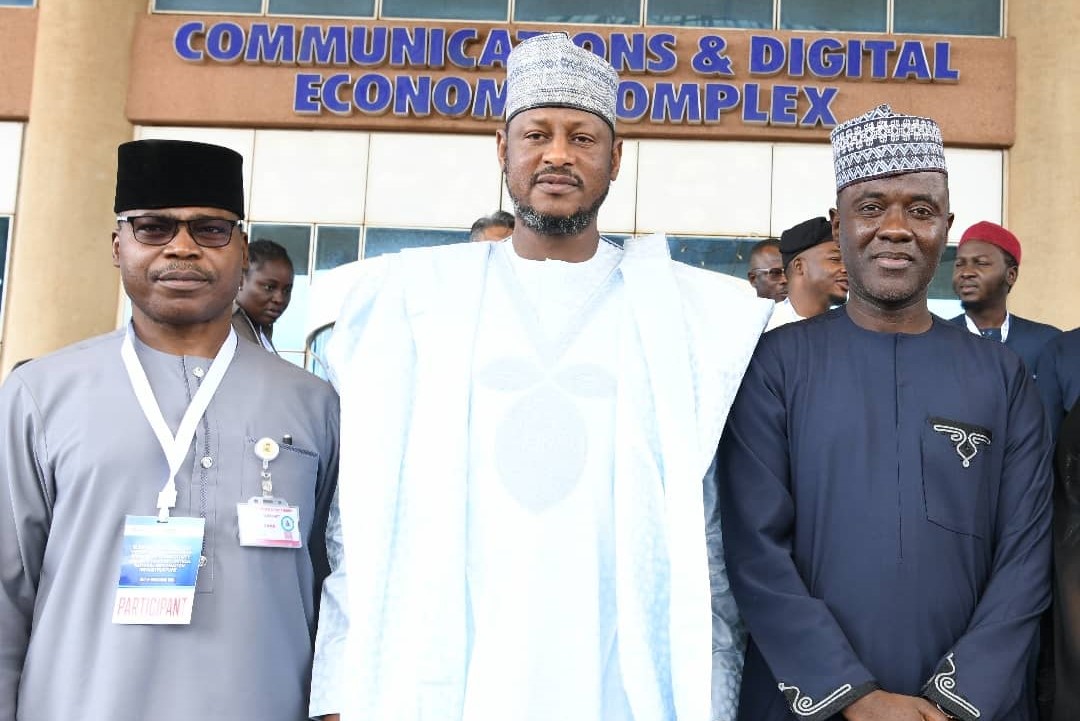
L-R: Director, Critical National Assets and Infrastructure Protection, Office of the National Security Advisers (ONSA), Enebong Effiom; Executive Governor, Katsina State, Dikko Radda and Executive Vice Chairman/Chief Executive Officer, Nigerian Communications Commission (NCC), Dr. Aminu Maida, during a business roundtable on broadband investment and critical national infrastructure protection hosted by the Commission in Abuja on Wednesday (October 8, 2025).