
By Emma Okonji, Online Editor, Thisday Newspaper
“Good afternoon Publisher. I enjoyed reading your book on ‘The Pilgrim Trial’. Your story is touching and inspiring. I particularly enjoyed Chapter 24 where you discussed your testy, but overcoming married life…
But I am particularly happy that all your daughters have embraced Christianity and they are following the way of God. That is a good legacy you have planted in your family.
You said in your book, and I quote you: ‘If my stories remind one reader to keep faith, to choose integrity, to forgive quickly, or to trust the unseen hand that leads, then my work on earth has not been in vain.”
Please be rest assured that I am one of the readers of your book that has further strengthened his faith to trust the unseen hand that leads, just because I read your book and got inspired.
So your work on earth is not in vain…Q.E.D.
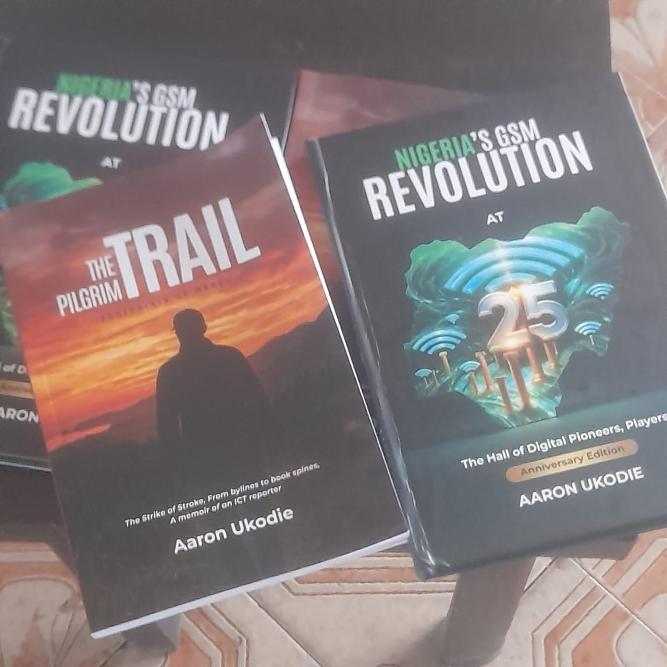
Notes on The Pilgrim Trail: Footprints of Mercy by Aaron Ukodie
By Muyiwa Akintunde , journalist, author, PR consultant
This book is not his usual tech book by a tech reporting icon — it’s his memoir. It is a deeply personal account of the author’s life journey — from his early years, his 40+ year career chronicling Nigeria’s telecom revolution, his Christian faith, and most powerfully, his near-death experience after suffering a stroke in 2023.
The central message: Mercy is deeply explored. You’ll read how God’s mercy sustained Aaron when medicine, strength and connections failed. He writes with his left hand because his right hand and leg were affected by the stroke, yet he still completed two books under physiotherapy.
The strengths of the book includes honesty and humanity. Unlike many memoirs that glorify the author, Aaron’s is vulnerable. He documents his physical limitations, his fear, his recovery, and his dependence on grace. It reads like Psalms — lamentation and thanksgiving together.
As Nigeria’s pioneer ICT reporter, the historical value of The Pilgrim Trail is significant as the narration connect with national milestones — from NITEL days to the GSM launch of August 2001. The book is a masterclass in how to preserve sector history.
The title is deliberate. Aaron frames life as a pilgrimage, not a race, giving his work a spiritual depth. He draws from the Spiritual and Corporal Works of Mercy — to instruct the ignorant, comfort the afflicted, feed the hungry, visit the sick. It is both memoir and sermon.
The most powerful chapter is his stroke testimony. For anyone facing health or career setbacks, it is a testimony that purpose can continue even when the body is limited.
The book is, however, short on editorial tightening — it feels like a man in a hurry to testify before time runs out. It could have used more dates, photos, and footnotes for younger journalists who didn’t witness the pre-GSM era.
It blends personal memoir with industry history — some readers may want more of one and less of the other.
All said, The Pilgrim Trail is a must-read for journalists, Christians, and anyone going through recovery. It is not just a book, it is a testimony. In a profession that celebrates scoops and bylines, Aaron reminds us that the greatest scoop is MERCY.
By Stanley Obienu Esq

This memoir of an ICT reporter, Aaron Ukodie, “The Pilgrims Trail, footprints of mercy, the strike of stroke, from bylines to book spines” is a delightful and captivating read.

From the very first pages, the author draws the reader into a remarkable journey that is both personal and deeply engaging. This book is *easy to start reading and surprisingly difficult to put down*.

One of the greatest strengths of the book is its language. The author writes in a *warm, friendly and conversational style,* making the reader feel less like an audience and more like a friend being taken through the events and experiences of a life. There is no unnecessary complexity in the narration; the simplicity of expression actually makes the story more powerful and accessible.

The book is also rich in *clear and vivid imagery*. As I read, I did not merely encounter descriptions of places, people and experiences—I could almost *see them, feel them and live through them.* Aaron Ukodie’s ability to bring scenes and memories to life makes the reading experience almost cinematic. At several points, it feels as though the reader is physically present, walking alongside the author through the different chapters of life.

What makes the memoir particularly appealing is the authenticity behind the narrative. It carries the warmth of personal reminiscence while preserving the excitement of a compelling story. Each experience seems to open another door, creating a natural curiosity about what comes next.

In my view, this is more than simply an account of someone’s special experiences in life; it is an *invitation to journey with the author through memories, experiences, challenges, relationships and milestones.*

The writing is simple without being simplistic, descriptive without being overwhelming, and personal without losing its appeal to the wider reader.

*It is a book that welcomes you gently, captures your attention naturally, and before you realise it, has carried you several chapters forward.*

Once you begin, you may find yourself saying, *“Let me just read one more page,”* only to discover that you have read several more chapters.

It is, indeed, *a beautiful, engaging and memorable memoir, easy to read, difficult to put down, and vivid enough to make the reader feel as though they are living in the pages.*

– Stanley Obienu, Esq.

    A Lawyer, an Educationist and    a Teacher of the Bible