
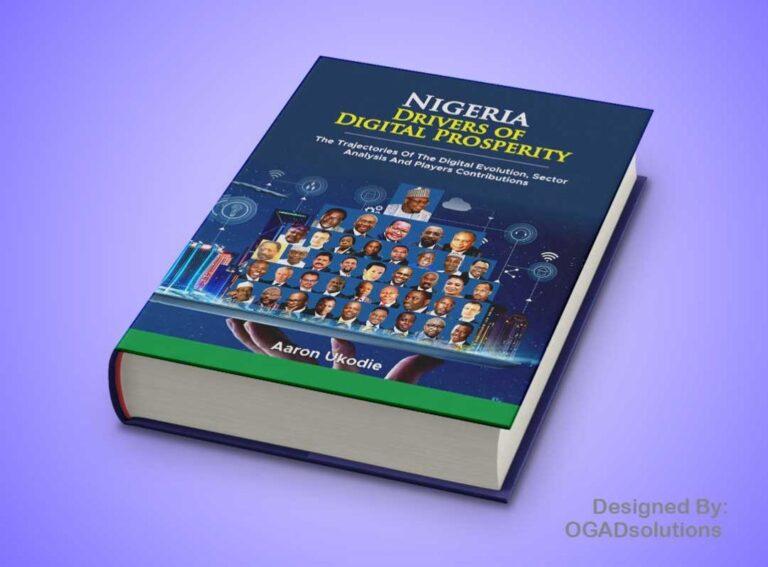
BOOK TITLE: NIGERIA: DRIVERS OF DIGITAL PROSPERITY
Sub-Title: The Trajectories of the Digital Evolution, Sector Analysis and Players’ Contributions
(This is a three-deck title inclusive of kicker and rider of the book title)
NUMBER OF PAGES: 472
AUTHOR: Aaron Ukodie (Nigeria’s Pioneer ICT Journalist)
PUBLISHERS: AJOMEDIA LIMITED (Nigeria)
EDITION: July 2022
PRINTED IN: Nigeria
PRICE:
REVIEWER: Olubayo Abiodun

In the emerging global economy, powerful nations now classify areas such as Information, Technology, Telecommunications, and Computing as the core of new power configurations. Anyone aiming for relevance in the global arena must give attention to computing skills, data analysis, robotics, cybersecurity, programming, business development and sales, blockchain, fintech, the food value chain, logistics, hospitality and tourism, sports, music, entertainment, creative arts, fashion, and automobile technologies. These are the frontiers where in-demand global skills are being harnessed. Brands like Netflix, Google, Tesla, Apple, Amazon, and Alibaba are already dominating these spaces. It is the realm of the millennial.
This is the pedigree that Nigeria: Drivers of Digital Prosperity, authored by Aaron Ukodie, brings to the fore. It is an interesting, intriguing, and lucidly written book—delivered in simple prose—that documents the full span of Nigeria’s Telecommunications, Technology, and Computing evolution in a single volume.
This well-documented work presents an experiential perspective by the author who, for more than 36 years, has consistently chronicled the events, policies, and players—both active and passive—that have shaped Nigeria’s ICT and Computer space across socio-economic milestones.
The foundational years and the journey to our current state are captured with rare details, some of which have never been previously documented. The roles played by actors in both public and private sectors, and the institutional perspectives that shaped the thriving ICT ecosystem in Nigeria, are vividly explored.
Instead of organizing the book into traditional chapters, the author opted to classify themes and sub-themes under five broad sections across the 472-page volume.
This effort by the author provides students, researchers, and industry enthusiasts an opportunity to uncover some of the key but cryptic roles played by individuals and institutions in the country’s critical economic and developmental journey.
Section One delves into the formative years of telecommunications evolution in Nigeria—predating the nation’s independence. It provides detailed narration on the pathways to expanding telecommunications to every corner of the nation. The section reveals the parochial motives behind the introduction of this critical infrastructure by colonial authorities.
The book also covers the transition from colonial telecom structures, town-by-town rollout tracking, and the logic behind those location choices—offering insights into the foreign powers’ disinterest in inclusive leadership. It further explores how telecom knowledge was gradually transferred to a select few Nigerians.
Equally well-documented are the origins of the Public Switched Telephone Network (PSTN), alongside a comprehensive exposition on concepts like globalisation, deregulation, liberalisation, commercialisation, and privatisation within the sector. These discussions are essential for understanding the foundation of today’s telecoms success story.
Section Three—arguably the most relatable for many readers—focuses on the pivotal era when Nigeria’s telecoms sector gained global attention. The author explores the creation of the telecommunications regulator, the daunting mandate before it, and the many setbacks leading up to the successful Digital Mobile Licence (DML) auction.
The book details the intense political intrigues, including attempts to oust Dr. Ernest Ndukwe from the NCC, the influence of late General Sani Abacha and the Chagoury family, and the heroic interventions of then Vice President Atiku Abubakar, NCC Board Chairman Ahmed Joda (late), and Ndukwe himself, which eventually led to Nigeria’s telecoms breakthrough.
Further, the book chronicles Nigeria’s broadband growth and the strategic role played by NIGCOMSAT in paving the way for 5G rollout.
Why was Surulere dubbed “Nigeria’s Silicon Valley” in the 1980s? What role did Chams play in Nigeria’s computing ecosystem? How did corporate Nigeria, including UAC, Unilever, and First Bank, pioneer data communications? These and other intriguing historical revelations are presented in detail.
The book also explores how Nigeria’s tertiary institutions struggled to align with global ICT trends. Section Two captures the shift from brick-and-mortar to virtual classrooms and the issues that arose during the transition. It highlights the roles of WAEC, NECO, and JAMB in embracing digital exam platforms, offering deep insights into the journey from paper-based exams to electronic testing.
The development and delays in the formulation of Nigeria’s national IT policy—due to power struggles—are also explored, along with the evolution of fraternal ICT industry associations and the eventual establishment of NITDA.
Notable individuals who shaped the ICT landscape—including Ministers, CEOs, and leaders of blue-chip companies—are profiled. The book offers a rich mixture of visionary leadership, ethical commitment, and sometimes, unfortunate missteps.
These include the contributions of late Ahmed Joda, late Olawale Ige, Ernest Ndukwe, Richmond Aggrey, Raymond Akwule, Bashir and Nasir El-Rufai, Senator Annie Okonkwo, Demola Aladekomo, Leo Stan-Ekeh, Austin Okere, Chris Uwaje, Titi Omo-Ettu, Emmanuel Ekuwem, Florence Seriki, Gerald Ilukwe, Gbenga Adebayo, and Lanre Ajayi.
The final section examines the pivotal role of the ICT media in Nigeria’s digital transformation. It chronicles the rugged journey of early ICT journalists—fighting for space in newsrooms dominated by politics, business, and crime beats—and how they evolved into respected publishers and industry stakeholders.
The book also highlights delicate moments, including how journalists narrowly escaped entrapment during a military coup, underscoring the complex interplay between the press and national security.
In terms of layout, design, and formatting, the book meets professional standards. The typeface, binding, and visual layout enhance readability and make for an engaging experience, while the thematic structure helps the reader digest each core area of Nigeria’s ICT development.
This book stands out for its unique presentation of statistics, narratives, values, and factual documentation of Nigeria’s ICT journey—from the pre-independence era to the present.
Conclusion
This book digs deep into Nigeria’s ICT roadmap, connecting the footprints from the analogue past to a digital present, and projecting a virtual future filled with promise.
However, this should not discourage other chroniclers from offering their own perspectives. Many veterans in this hall today are encouraged to document their experiences, just as Aaron Ukodie has admirably done.
I highly recommend this book for stakeholders in both the public and private sectors. Its insights can provoke strategic dialogues and deeper understanding to further expand the ICT space in Nigeria.
Aaron Ukodie, with several acclaimed titles to his name—including Phones 4 All (2004), Ndukwe & Telecom Regulation (2007), The Story of NITEL (2015), Nigeria @ 50: NITDA in National Development, The Lead Story (2014), and Olagunju: Strides of a Porter’s Son (2013)—brings unmatched pedigree. He also co-authored the 600-page book The Making of the Nigerian Flagship: A Story of The Guardian.
Institutions like NCC, NITDA, NBC, NIPOST, MTN, Airtel, Globacom, 9mobile, MainOne, Nigcomsat, Zinox Technologies, and others would do well to include this book in their collections.
When a revised edition becomes necessary, I hope to see the inclusion of maps, charts, infographics, and iconic photographs that visually tell the story of this sector. Also, detailed analytics on human capital growth and unresolved stories—like the mysterious death of Engineer Charles Joseph, late President of Mobitel—should be considered. Interviews with living legends such as Ndukwe, Professor Pat Utomi, Demola Aladekomo, Cletus Iromantu, and Bashir El-Rufai would further enrich the narrative.
On behalf of the author, readers are kindly asked to overlook minor typographical errors.
Thank you, and happy reading.
By Olubayo Abiodun
2022