

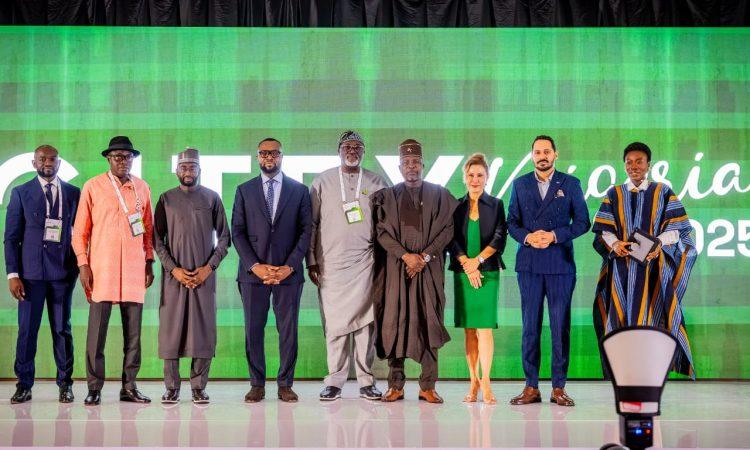
The Honourable Minister of Communications, Innovation and Digital Economy, Dr. Bosun Tijani, has urged African countries to embrace artificial intelligence (AI) as a catalyst for productivity, competitiveness, and job creation.
Speaking at the Gulf Information Technology Exhibition (GITEX) Nigeria 2025 in Abuja, Tijani warned that Africa risks being left behind if it fails to accelerate AI adoption across critical sectors.
He noted that nations already applying AI are recording exponential gains in agriculture, finance, logistics, and education, while many African economies still depend on guesswork and outdated practices.
“AI will widen the productivity gap between nations. Countries that are already ahead will move even faster, while those still catching up will find it even more difficult,” the Minister cautioned.
Citing lessons from Brazil and South Africa, Tijani pointed to AI-driven precision agriculture—where farmers deploy soil sensors, predictive analytics, drones, and satellite imaging—to boost yields and cut costs by up to 95 percent. In comparison, Nigerian farmers still average 2.5 tonnes of maize per hectare, far below Brazil’s 10–12 tonnes.
To shape Africa’s AI future, the Minister outlined four priorities:
- Balancing sovereignty with collaboration – developing national AI strategies while pursuing shared standards.
- Leveraging Africa’s youthful population – equipping young people with digital skills through programmes like the 3 Million Technical Talent (3MTT) initiative.
- Digitising African realities – creating local datasets in agriculture, health, and education to ensure AI reflects African contexts.
- Investing in infrastructure – expanding affordable connectivity and clean energy to power AI growth.
Tijani stressed that Africa must become a producer—not just a consumer—of innovation.
“If we cannot close this gap, Africa risks becoming a continent that imports food, imports services, and imports innovation. That is not the Africa we want,” he said.
Similarly, the Director-General of the National Information Technology Development Agency (NITDA), Mallam Kashifu Inuwa Abdullahi, urged African nations to collaborate on building shared AI infrastructure to avoid exclusion from the Fourth Industrial Revolution.
Inuwa noted that while Africa played a peripheral role in past industrial revolutions, AI offers the continent a chance to lead. He cited Epoch AI research, which projects that automation could grow the global economy by 20 percent and potentially double its size within five years.
He outlined four pillars for AI capacity-building in Africa:
- Human Capital – leveraging Africa’s youthful, digitally savvy population through initiatives like 3MTT and Digital Literacy for All.
- Infrastructure – expanding connectivity, building data centres, and enabling shared computing power for local data processing.
- Policy and Legal Frameworks – with Nigeria already pioneering national AI strategies under Tijani’s leadership.
- Enabling Ecosystem – supporting start-ups, AI research, and partnerships, including funding for 45 Nigerian AI-driven start-ups.
Inuwa also underscored the need to build local large language models (LLMs) to safeguard African cultures and values in global AI systems.
Wrapping up the Abuja summit, Trixie LohMirmand, Executive Vice President of the Dubai World Trade Centre (DWTC), urged Nigeria to secure its place in the AI economy through deeper global collaboration.
She emphasized that Nigeria’s growing population—set to rise from 230 million today to 400 million by 2050—positions the country as a digital frontier.
“Nigeria is not defined by the headlines or its current challenges, but by the scale of opportunities of tomorrow. Those who stay the course are the future of Africa,” LohMirmand said.
She reaffirmed DWTC’s commitment to Africa, adding that GITEX Nigeria would provide a global platform for Nigerian start-ups, SMEs, and innovators to secure partnerships and compete internationally.